Woman in a navy La Nageuse swimsuit walking into the waves

Longe-côte: The Sea Walk That Does You Good

Claire Baillet
By Claire Baillet, ikonō founder · 6 min read

Longe-côte: The Sea Walk That Does You Good

Water up to your waist, wind on your face, a group moving at the same pace along the beach. Born in Dunkirk some twenty years ago, longe-côte, or sea walking, has spread along the French and Belgian coasts and well beyond. And you can do it all year round.

Key points

  • You walk in the sea, with the water between your navel and your armpits
  • An accessible activity that adapts to different levels
  • Under a wetsuit, or on its own in summer: a one-piece that stays in place

What is longe-côte?

Longe-côte, also called sea walking or aquatic coastal walking, means walking in the sea, parallel to the shore, with the water somewhere between your navel and your armpits. You move forward as a group, with or without a paddle depending on the practice.

It all started in 2005 in Dunkirk. Thomas Wallyn, a rowing coach, was looking for a way to strengthen his rowers without straining their joints. He began walking in the water, paddle in hand, testing the current and the waves… and found a pleasure he hadn’t expected. He calls it “serendipity” himself. Those who followed him became the first “longeurs”. Today the discipline is overseen by the French Hiking Federation.

Did you know?

Plenty of women walk in the sea: at the 2024 Provence-Alpes-Côte d’Azur regional championship, 188 of the 302 participants were women, more than six in ten. And in competition, the fastest walkers move through the water at 4 to 5 km/h.

Much more than a French trend

From the north coast of France, longe-côte has spread to Spain, where it’s called “marcha acuática”, to Italy, Morocco, Tunisia, the United Kingdom under the name “sea wading”, and even to an island in Tasmania, Australia.

In Belgium, you can try it with a club in Oostduinkerke, in a guided session. Sessions are also offered in Knokke-Heist. And even in Flanders, people happily say “longe-côte” rather than “zeewandelen”.

The benefits of longe-côte

A complete sport, without jolts. Moving forward against the resistance of the water works your legs, core, back and arms. The Federation describes it as muscle and cardio training without trauma to the joints.

Stamina and balance. Walking in the water builds endurance and balance. The pace can be adapted to each woman’s level and fitness.

A moment for yourself, and with others. The sea, the sky, the group moving together: you come out tired and calm at the same time.

Woman in a navy La Nageuse swimsuit walking through the surf
La Nageuse in navy: a sporty cut that stays in place, in the waves as on the sand.

Getting started with longe-côte

The easiest way is to join a guided session. The instructor knows the currents, the authorised areas and the right depth, which matters as much for technique as for your body. Sessions stay within 300 metres of the shore, with one instructor and one assistant for no more than twenty people.

A session usually lasts around an hour, alternating between walking against the current and with it. Before you start, and even more so if you’re returning to activity after a break, surgery or treatment, talk to your doctor.

What to wear for longe-côte

In the warm season

A sporty one-piece, suitable water shoes and sun protection. Depending on the practice, a paddle or other propulsion accessories may be used.

From October to April

A neoprene wetsuit whose thickness depends on the water temperature, water shoes, sometimes gloves and a hood. And underneath, always a swimsuit.

In midwinter on the North Sea, the kit is complete: wetsuit, water shoes, gloves, hood. One Belgian walker joked on the radio that, dressed like that, he looks more like a seal than the heroic lifeguard from Baywatch. That’s longe-côte too.

Summer, in a swimsuit: Sylvie in Les Sables-d’Olonne

When the water allows and the club agrees, some walkers leave the wetsuit behind. Sylvie, an ikonō customer, is one of them: she walks in the Atlantic every week in Les Sables-d’Olonne.

Sylvie, an ikonō customer, in a red kaftan on the beach in Les Sables-d’Olonne

“In summer, I do longe-côte in my Nageuse. I appreciate its lining in the Atlantic, which can sometimes be bracing, but above all it’s the support and the comfort: I forget I’m wearing it and enjoy the moment. When I get out, I slip on my kaftan and cycle home.”

Sylvie, sea walker in Les Sables-d’Olonne

What to wear under your wetsuit

In the sea, your swimsuit works hard: the waves push, the current pulls, your arms move. And under a wetsuit, you should be able to forget it for a whole hour.

  • One-piece: it stays in place in the waves better than a two-piece.
  • Wide straps: they don’t slip when you raise your arms, and don’t dig in under the neoprene.
  • Wire-free support: nothing presses under the wetsuit.
  • Flat seams and a soft lining: no rubbing, even after a long walk.
  • Salt- and chlorine-resistant fabric: it keeps its shape, walk after walk.

Without a wetsuit, your swimsuit is in contact with your skin, the salt water and the sand for the whole session. ikonō swimsuits are lined with a soft, second-skin recycled tulle, certified OEKO-TEX® Standard 100.

“That first swim, on an island in Brittany, in a pretty swimsuit that stayed in place despite the waves, was a moment when I felt strong.”

Agathe, ikonō customer

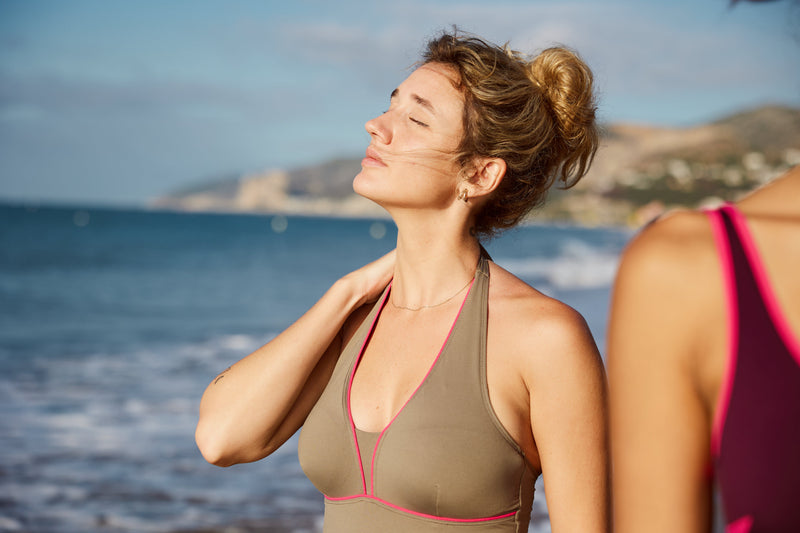
That day, Agathe was wearing La Versatile in Oasis green: a halter neckline that ties at the neck, more coverage at the neckline and wire-free support. For a sportier look, La Nageuse, Sylvie’s swimsuit, was designed for movement: a sporty cut, recycled fabric resistant to chlorine and salt water, UPF 50. Both have invisible pockets for one, two or no prosthesis.

La Nageuse, made to move

Wide straps, wire-free support, salt- and chlorine-resistant fabric, UPF 50.

Discover La Nageuse

Your questions

Do you need to know how to swim to do longe-côte?

Not necessarily. Longe-côte is done at a depth where you can stand. You do need to be comfortable in the water, though, and when you’re starting out it’s best to join a guided session.

At what age can you start?

From teenagers to people over 70, longe-côte brings all generations together, even in competition. Medical advice is recommended before you start.

Which wetsuit for longe-côte?

A neoprene wetsuit whose thickness depends on the water temperature: around 5 mm in very cold water (7 to 12 °C), 4 mm between 12 and 17 °C, 2 to 3 mm above that. Your club will advise you; some offer rentals for the first sessions.

What should you wear under the wetsuit?

A one-piece swimsuit with wide straps, flat seams and a soft lining. It shouldn’t slip or rub during the whole session.

And in summer, without a wetsuit?

When the water allows and your club agrees: a sporty one-piece, suitable water shoes and good sun protection. A UPF 50 fabric also protects the skin it covers.

And you, have you ever walked in the sea? Tell us about your first time: we love these stories.

Water up to your waist, wind on your face, a group moving at the same pace along the beach. Born in Dunkirk some twenty years ago, longe-côte, or sea walking, has spread along the French and Belgian coasts and well beyond. And you can do it all year round.

Key points

  • You walk in the sea, with the water between your navel and your armpits
  • An accessible activity that adapts to different levels
  • Under a wetsuit, or on its own in summer: a one-piece that stays in place

What is longe-côte?

Longe-côte, also called sea walking or aquatic coastal walking, means walking in the sea, parallel to the shore, with the water somewhere between your navel and your armpits. You move forward as a group, with or without a paddle depending on the practice.

It all started in 2005 in Dunkirk. Thomas Wallyn, a rowing coach, was looking for a way to strengthen his rowers without straining their joints. He began walking in the water, paddle in hand, testing the current and the waves… and found a pleasure he hadn’t expected. He calls it “serendipity” himself. Those who followed him became the first “longeurs”. Today the discipline is overseen by the French Hiking Federation.

Did you know?

Plenty of women walk in the sea: at the 2024 Provence-Alpes-Côte d’Azur regional championship, 188 of the 302 participants were women, more than six in ten. And in competition, the fastest walkers move through the water at 4 to 5 km/h.

Much more than a French trend

From the north coast of France, longe-côte has spread to Spain, where it’s called “marcha acuática”, to Italy, Morocco, Tunisia, the United Kingdom under the name “sea wading”, and even to an island in Tasmania, Australia.

In Belgium, you can try it with a club in Oostduinkerke, in a guided session. Sessions are also offered in Knokke-Heist. And even in Flanders, people happily say “longe-côte” rather than “zeewandelen”.

The benefits of longe-côte

A complete sport, without jolts. Moving forward against the resistance of the water works your legs, core, back and arms. The Federation describes it as muscle and cardio training without trauma to the joints.

Stamina and balance. Walking in the water builds endurance and balance. The pace can be adapted to each woman’s level and fitness.

A moment for yourself, and with others. The sea, the sky, the group moving together: you come out tired and calm at the same time.

Woman in a navy La Nageuse swimsuit walking through the surf
La Nageuse in navy: a sporty cut that stays in place, in the waves as on the sand.

Getting started with longe-côte

The easiest way is to join a guided session. The instructor knows the currents, the authorised areas and the right depth, which matters as much for technique as for your body. Sessions stay within 300 metres of the shore, with one instructor and one assistant for no more than twenty people.

A session usually lasts around an hour, alternating between walking against the current and with it. Before you start, and even more so if you’re returning to activity after a break, surgery or treatment, talk to your doctor.

What to wear for longe-côte

In the warm season

A sporty one-piece, suitable water shoes and sun protection. Depending on the practice, a paddle or other propulsion accessories may be used.

From October to April

A neoprene wetsuit whose thickness depends on the water temperature, water shoes, sometimes gloves and a hood. And underneath, always a swimsuit.

In midwinter on the North Sea, the kit is complete: wetsuit, water shoes, gloves, hood. One Belgian walker joked on the radio that, dressed like that, he looks more like a seal than the heroic lifeguard from Baywatch. That’s longe-côte too.

Summer, in a swimsuit: Sylvie in Les Sables-d’Olonne

When the water allows and the club agrees, some walkers leave the wetsuit behind. Sylvie, an ikonō customer, is one of them: she walks in the Atlantic every week in Les Sables-d’Olonne.

Sylvie, an ikonō customer, in a red kaftan on the beach in Les Sables-d’Olonne

“In summer, I do longe-côte in my Nageuse. I appreciate its lining in the Atlantic, which can sometimes be bracing, but above all it’s the support and the comfort: I forget I’m wearing it and enjoy the moment. When I get out, I slip on my kaftan and cycle home.”

Sylvie, sea walker in Les Sables-d’Olonne

What to wear under your wetsuit

In the sea, your swimsuit works hard: the waves push, the current pulls, your arms move. And under a wetsuit, you should be able to forget it for a whole hour.

  • One-piece: it stays in place in the waves better than a two-piece.
  • Wide straps: they don’t slip when you raise your arms, and don’t dig in under the neoprene.
  • Wire-free support: nothing presses under the wetsuit.
  • Flat seams and a soft lining: no rubbing, even after a long walk.
  • Salt- and chlorine-resistant fabric: it keeps its shape, walk after walk.

Without a wetsuit, your swimsuit is in contact with your skin, the salt water and the sand for the whole session. ikonō swimsuits are lined with a soft, second-skin recycled tulle, certified OEKO-TEX® Standard 100.

“That first swim, on an island in Brittany, in a pretty swimsuit that stayed in place despite the waves, was a moment when I felt strong.”

Agathe, ikonō customer

That day, Agathe was wearing La Versatile in Oasis green: a halter neckline that ties at the neck, more coverage at the neckline and wire-free support. For a sportier look, La Nageuse, Sylvie’s swimsuit, was designed for movement: a sporty cut, recycled fabric resistant to chlorine and salt water, UPF 50. Both have invisible pockets for one, two or no prosthesis.

La Nageuse, made to move

Wide straps, wire-free support, salt- and chlorine-resistant fabric, UPF 50.

Discover La Nageuse

Your questions

Do you need to know how to swim to do longe-côte?

Not necessarily. Longe-côte is done at a depth where you can stand. You do need to be comfortable in the water, though, and when you’re starting out it’s best to join a guided session.

At what age can you start?

From teenagers to people over 70, longe-côte brings all generations together, even in competition. Medical advice is recommended before you start.

Which wetsuit for longe-côte?

A neoprene wetsuit whose thickness depends on the water temperature: around 5 mm in very cold water (7 to 12 °C), 4 mm between 12 and 17 °C, 2 to 3 mm above that. Your club will advise you; some offer rentals for the first sessions.

What should you wear under the wetsuit?

A one-piece swimsuit with wide straps, flat seams and a soft lining. It shouldn’t slip or rub during the whole session.

And in summer, without a wetsuit?

When the water allows and your club agrees: a sporty one-piece, suitable water shoes and good sun protection. A UPF 50 fabric also protects the skin it covers.

And you, have you ever walked in the sea? Tell us about your first time: we love these stories.

Our swimsuits

Prosthesis pockets, wire-free, UPF 50.

Shop the collection

Read next

Advice and stories from women on the move.

The ikonō letter

Advice, stories and news, twice a month

Tips on choosing and caring for your swimsuit, portraits of women on the move, and our new cuts before anyone else.